


Please note that we are open by appointment only (except for click and collect pickups once notified ready).
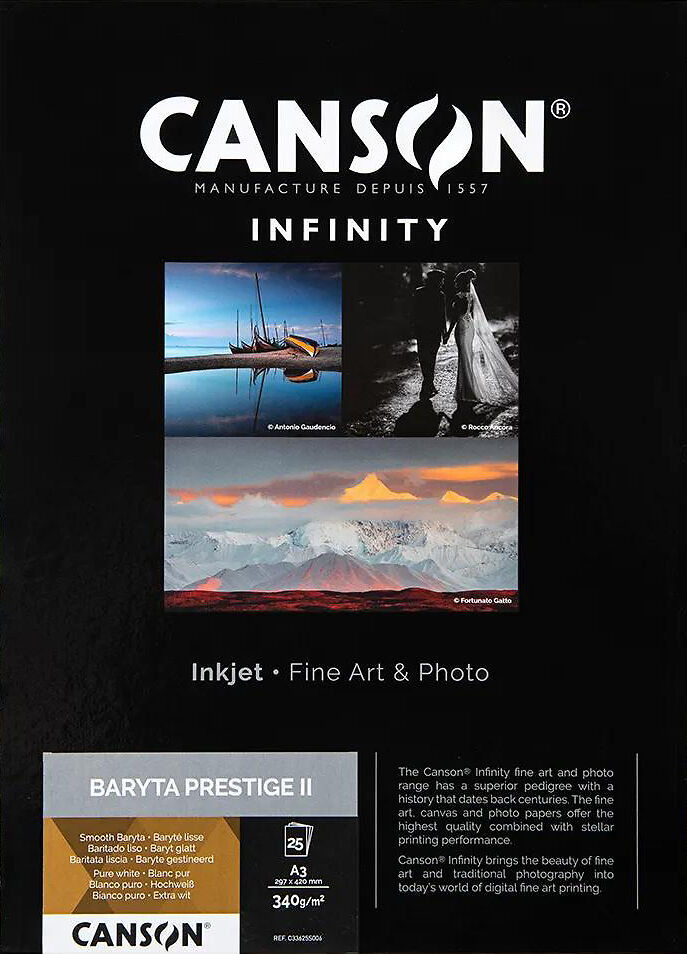
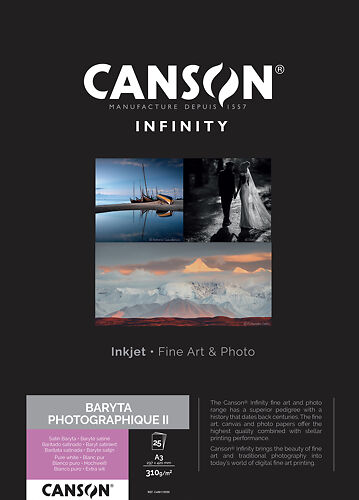
A heavyweight Baryta gloss paper with a natural white tone, great for those who prefer the look and feel of traditional darkroom papers.
This paper is the new jewel in Canson's crown, a paper they've tried hard to make into the premier darkroom style inkjet paper available today. Absolutely worth a try!
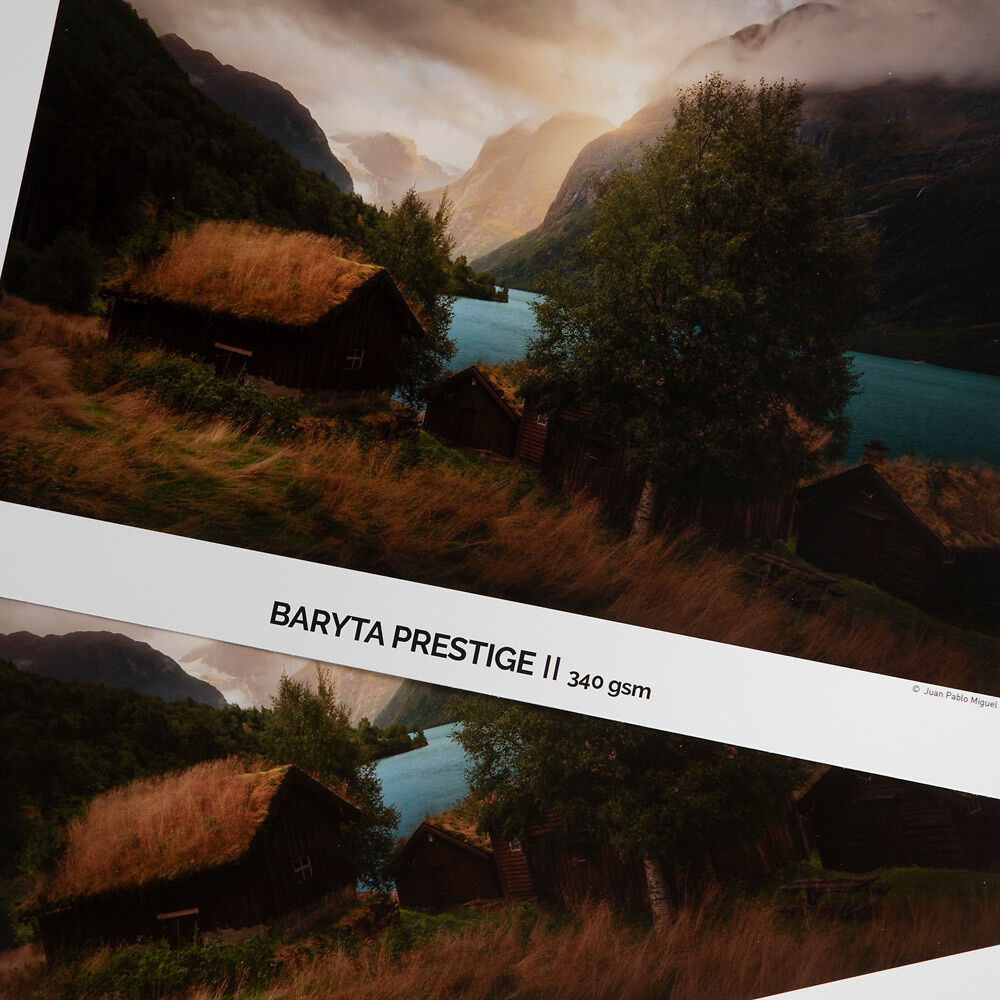
Canson Infinity Baryta Prestige II 340gsm has the aesthetic of a traditional darkroom paper, which is achieved by adding a coating of barium sulphate prior to the inkjet receiving layer.
The paper has and a natural white base which is achieved without the use of artificial brightening agents (OBAs). The gloss finish of Baryta Prestige II enhances the deep blacks and pure whites and intensifies the vibrant colour gamut. The paper offers exceptional image quality, detail, and tonal range to produce superb black & white and colour images.
Produced on a mixed alpha-cellulose and cotton base, the paper has excellent handling characteristics and is FSC and ISO 9706 certified.
Construction
Fibre Based
Substrate
50% Cotton 50% Alpha Cellulose
(acid free)
Paper Weight
340 gsm
Surface Texture
Gloss
White Tone
White
Optical Brighteners?
Please note: Specifications are provided as a guide only.
We try very hard to keep these up to date and correct, but if a particular specification is really critical to you, then please double check the specification directly with the manufacturer. Some features may of course have caveats not fully described here.
To get more information about a particular specification, use the arrow to get a 'Specxplanation'.
Described simple, papers are constructed in two main ways:
Resin Coated papers are the 'modern' approach. These use less fibre and replace the fibre with resin (a nice name for plastic). This means these papers are relatively cheap, strong and robust, but tend to be less attractive to the touch, and accept less ink. They tend to have a clinical appearance and it's hard to write on the back of them. They tend to be popular in the consumer and wedding/portrait markets.
Fibre Based papers are traditional papers made without plastic, using only plant fibres. These tend to accept more ink and have a more attractive appearance, and these are the papers most of our customers favour. These papers
Environmental Concerns:
Resin coated papers are difficult or impossible to recycle because of their plastic content.
Fibre Based papers are fully recyclable and we thus strongly recommend you use fibre based papers whenever possible.

What is the paper base made from?
Possibilities include:
Is this paper acid free?
Acid in paper leads to earlier yellowing and the paper will also become brittle more quickly. Thus for a paper to be archival, it needs to be acid free.
Papers which are not acid free are generally best used for proofing (test printing), and shorter term purposes. That is, they are not considered to be a fine art level product, or suitable for print sales into the art or professional photography markets.
This does not, of course, mean these papers will vanish or discolour overnight - they generally still have life-spans suitable for commercial work and above or on par with e.g. typical photo chemistry papers. They are thus suitable to markets like signage, or the decor market (e.g. print sales for kiddies bedrooms, for example) - but should be avoided if you're trying to sell your work as a serious art level product.
In general, papers made from cotton are naturally acid free, which is one reason they are often favoured. Other fibres, like Kozo, are also naturally acid free. High grade wood pulp papers can also be made to be acid free, however, if the lignin/acid is removed from the pulp.
These days almost all papers are microporous coated - meaning they'll accept inks from both dye based and pigment printers well.
In years past, some papers had a swellable coating - designed to give a greater life to prints with dye based inks but this approach has fallen out of favour.
In 'gsm' - grams per square metre.
Not, technically, the same as paper thickness, but obviously correlated. The heft of the paper. European art papers are traditionally generally around the 300gsm mark. Asian papers historically tended to be lighter, 100 to 200 gsm.
Papers with a higher GSM tend to have more opacity, i.e. you see less through them.
The thickness of the paper, as supplied by the manufacturer. Also known as Caliper (as calipers are used to measure this value).
Unit are in millimetres (e.g. 0.5mm, half a millimetre), or microns/μm = micrometre, or thousands of a millimetre. I.e. 500 microns (μm) = 0.5mm.
(Note in many ways this a much more relevant figure than the more often quoated gsm - as it is thickness of a paper, more than weight, which determines how easily a printer feeds a paper).
What is the surface texture of the paper?
We divide this into six groups. We go by the appearance of the actual paper and not what the manufacturer might label the box with!
What is the white tone of the paper?
Measurement of the white tone of the paper, as supplied by the manufacturer, with the measurement standard they have used (where given). It's really best used e.g. as a comparison figure against other papers, rather than an objective figure for any one paper.
The value is often given as a percentage (with an ISO standard), or more usually as an LAB value (with a measuring standard). If you want to understand LAB, then we have information in Chapter Two of our Fundamentals of Digital learning resource.
Important - this is an average figure and not a specific guarantee that any particular sheet you might measure will be exactly this figure.
Does the paper contain chemicals in it to brighten its appearance?
We're using the value/description the manufacturer supplies (see also the White Tone and White Value specs).
In many cases, only a small amount is used to even out batches of cotton, and then only in the paper base, not the coating - in these cases, it is generally agreed such use of OBAs is essentially insignificant and will not materially impair the archival life of the paper.
More on this here.
What ink type (dye and/or pigments) can you use with the paper?
Also, if using pigment inks and you have a choice, should you use the Matte Black or Photo Black ink?
Confused about something, or just want some human to human advice?
Send us a question about this product.
We answer all enquiries, and promptly too!
You're also very welcome to ring us on 03 9329 4522 if you prefer.
Note this form is for pre-purchase enquiries, or support enquiries if you have bought this product from us. If you have bought this product from another supplier then please contact that supplier for support.
Videos from around the internet about the Canson Infinity Baryta Prestige II 340gsm.
Note we don't produce these, so we can't be responsible for the content, but we've tried hard to find useful videos about the product to help you decide if it's right for you and/or how to use it!
Les Walkling analyses Canson Infinity Baryta Prestige II
Celebrated landscape photographer Chris Ceaser previews the Canson® Infinity Baryta Prestige II paper.
At Image Science we support what we sell & we really mean that.
You're always welcome to email us for help - how to, technical support, troubleshooting, general tips - for the entire lifetime of the product.
With an unmatched track record for support, for more than 20 years in this industry, you can be sure we're not just a box moving store.