▪ We expect to start shipping these early July.
▪ Free Courier Shipping to most locations! (See notes).
Please note that we are open by appointment only (except for click and collect pickups once notified ready).
Even in 2024, IPS LCD monitors remain the best choice for most creative work, but OLEDs are definitely on their way now, and will bring both significant benefits and new challenges to creative work. As will e.g. MicroLED, should that ever actually arrive...
This is an introductory article on the technologies and their respective strengths and weaknesses in the context of various types of creative work.
Modern display technologies can be divided into two main groups - those that require backlighting - all LCDs, and those that do not - OLEDs.
Whilst there other of course other display technologies (CRT, Plasma, eInk, etc.) - really only LCD , and OLED, are relevant in the context of the modern computing environment.
LCDs (and the various sub types of LCDs) are by far the most common technology. Essentially, you can conceptually think of these as some backlights with filters in front of them to turn that light into the coloured pixels you ultimately see.
Non-backlit screens like OLEDs can just be thought of as a vast array of completely individual pixels that can each, individually, vary their own light from perfectly black (i.e. emitting not light at all), through to very bright and colourful.
Liquid Crystal Displays have been the dominant display technology in the world since the early 2000s. As the era of CRTs came to a close, we saw the rise of higher quality LCDs, and their subsequent entrance into the colour accurate monitor market.
Image Science was among the first to sell and support these monitors into the creative market, starting around 2005 or 2006...thus for almost 20 years now we have in fact been the primary supplier of colour accurate monitors in Australia for the three serious colour accurate brands - Eizo, BenQ and NEC (sadly NEC are no longer present in this market).
We began to replace our own high end Sony's Trinitron and Mitsubishi's Diamondtron displays in ~2005. Whilst these early LCDs were of course nowhere near the refined products we now enjoy, even the first Eizo LCD bought was overall a big step forward from the CRT units.
LCDs are now ubiquitous. They are cheap to produce, and, when you have a high quality IPS panel and appropriate surrounding electronics, can be excellent devices for most types of creative work. All the colour accurate LCD models use IPS panels as these are the benchmark for colour accuracy and good viewing angled.
In terms of visual advantages, modern LCDs have very good brightness and can display a wide colour gamut accurately. They can far exceed OLED peak brightness figures, advantageous for HDR, and because of their high brightness are often the best choice in very brightly lit environments. They are very cheap to run, requiring little power, and they (essentially) don't suffer from burn in, even when used to display static images for a long time.
Their chief disadvantage is their lack of contrast, because they lack good deep blacks. As the backlights are always emitting light, consequently that means the blacks are always, to some extent, lit up - and thus not really black at all. (See below for more about this).
LCDs have also, historically, suffered from issues with uniformity, with these issues again coming from the use of backlighting. Whether it is edge lighting (where light sources around the edge of the monitor are reflected inwards), or the backlight is a grid of LCDs, it's traditionally been difficult to get these displays perfectly even across the field of view, in terms of both brightness and colour accuracy/consistency.
In the 'traditional LCD' world, there are advanced efforts to try and mitigate these fundamental issues.
Modern LCDs are carefully tuned to make the backlighting more even across the field of view. This is easier and more effective with monitors not using edge lighting, as each grid of backlights can in theory be individually tuned and balanced.
This process only happens once, though, at the factory, so LCDs do tend to progressively get more 'dis-uniform' (uneven) over their lifespan.
MiniLED displays use a grid of smaller LED lights, each of which light up a sub-group of pixels - this means, when you want an area to be black, the display can turn off zones of the backlight grid. If the grid has enough zones, this is reasonably convincing and effective for video scenarios where frames are constantly changing. However, even with moving video, there is always some visible 'blooming' visible around high contrast areas, and there tends to be poor behaviour generally with low key areas (a sudden drop off from low key areas with detail, to unlit areas of pure black, that is quite noticeable).
These aspects makes MiniLED problematic for still image work, and particularly low key image work.
(Apple currently use MiniLED in some of their more expensive MacBooks and iPads, but by all reports are keen to move to OLED instead due to these sorts of issues - indeed we've now seen the first move in this regard with the latest iPad Pro models).
MicroLED panels use very small LEDs to control the light of each pixel individually, effectively making an LCD behave very similarly to an OLED as, as discussed below. With this in place, you effectively get the advantages of both LCDs and OLEDs, and so this is very promising - in theory.
The main issue here is that this technology is not yet affordably available to the mass market - so for now MicroLED is essentially just 'vapour-ware' in the current market.
The advantage of OLEDs comes from the fact that, instead, each individual pixel of an OLED emits and controls its own light - which is to say, each pixel is fully independent from it's neighbour in terms of the light and colour it outputs. And each pixel can also not emit any light - i.e. can be fully switched off.
This gives OLEDs their primary advantage - simply unequalled 'infinite' blacks. These intensely deep blacks give OLEDs their brilliant, life-like contrast. In short, the picture quality on a good OLED is the current benchmark of all display technologies.
Disadvantages of OLED are higher power use, and more limited life span of the organic components, especially if pushed hard - which can lead to burn in and a loss of achievable saturation over time. OLEDs also tend to have considerably lower peak brightness figures, so are generally less good in e.g. very bright rooms, and some argue they are less good for HDR. Viewing angles are also not quite as good as the best IPS LCDs.
I, and many others with a strong interest in display quality, would argue that the infinite blacks and OLEDs generally much better deep shadow behaviour are much more important than peak brightness for the overall quality of HDR display, in practise...especially as, even with HDR material, the vast bulk of what you are seeing lives in the lower brightness regions.
There is a bit of an obsession with peak brightness figures in the industry, though - I presume because having the higher brightness number is one way of claiming a particular display is 'the best' - but, as ever, it's easy for specification to hide the true story of visual quality!
These issues with OLED are being tackled by the emergence of new double layer OLED panels - AKA Tandem OLEDs.
This is where two layers of OLED pixels are sandwiched together. Because each layer is not pushed as hard, the net effect is a high brightness panel, with increased longevity, alongside the traditional OLED benefits. This too is very promising technology, and seems to now be headed towards the market more quickly/affordably then MicroLED.
I suspect in the medium term, dual layer OLEDs are likely to be the clear front runners for best display technology. It's early days yet for dual layer OLEDs, but Apple are currently leading the way here with a dual layer OLED in their latest iPad Pro - which they themselves describe as the best display (in sheer visual quality terms) to ever appear in a consumer electronics device.
Another aspect of OLEDs worth mentioning is that, to date, almost all of them have a glossy coating on the panel. For me, this is one of the chief remaining issues with OLEDs and a really obvious flaw with them. Glossy screens means reflection, and that means inaccuracy in deep shadow tones because they are strongly influenced but the things around them - e.g. the colours of the shirt you're wearing when you sit in front of them!
(I honestly have no idea why this has gone on so long - but it seems that manufacturers are finally realising that a lot of people dislike glossy panels. Case in point - the most well reviewed TV of 2024 is a new high end OLED model from Samsung with one huge and obvious improvement - a matte panel coating...).
Having established that the primary display technologies of note are LCD and OLED, let's discuss using these monitors in the context of various types of content creation work.
The default choice for content creation work has been high quality, IPS LCD panels, for pretty much the last 20 years.
IPS is the most colour accurate type of LCD panel, and they have very good viewing angle characteristics, and so are without question the de facto standard to beat in high quality LCD monitors. Literally all the monitors we carry at Image Science, currently, are IPS LCDs.
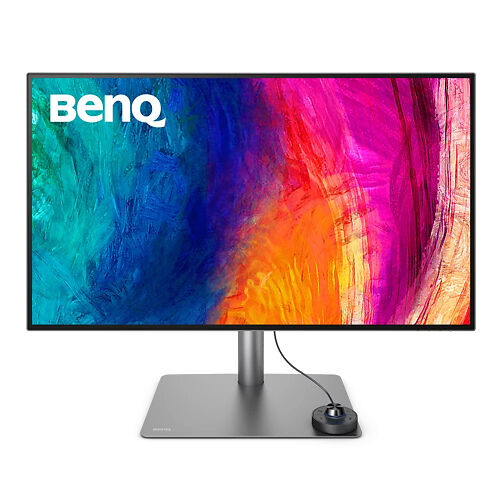
The price paid for these positive characteristics, however, is steep - the notorious 'IPS glow'. Combined with backlight bleed, the result is milky (often bluey) blacks, that are not really black at all, and are often prone to dis-uniformity issues. This means these monitors are best used in fairly reasonably lit environments and where they eye does not tend to notice these negatives - but if used in a scenario where the ambient light is lower, these defects become quickly obvious to the eye. Even monitors that feature 'IPS Black' or similar technologies (like the Eizo CG2700X and BenQ PD3225U) still suffer from these issues, albeit to a noticeably lesser degree.
This is why LCD based TVs are fundamentally the wrong choice for most people - as they do most of their watching at night, in lower lit rooms, the environment and the capabilities of the display are working against each other. Of course there are sports lovers etc. who prioritise daytime watching, so this is not a hard and fast rule, but for e.g. typical family viewing, an LCD will result in a significant quality compromise, even if the TV has systems like mini LED based local dimming.
In the TV domain, therefore, OLED becomes the obvious solution to this problem. However, to date, OLEDs have not made any impact on the content creation monitor market.
This is for a variety of reasons - for example, achieving high enough levels of colour accuracy, gamut, and uniformity, for desktop content creation work - at an affordable price, is challenging. And of course there are issues and worry about burn in, when a desktop monitor is obviously and inevitably used to display the same content for long periods of time.
It's also a case of chicken and egg - as there is as yet no real market for smaller, desktop size panels, no one is making them - most OLEDs coming off production lines are a minimum of 32 inches, and usually much larger again - just not what most people are looking for on their desk (27 inch monitors being by far the most popular size).
OLEDs are sometimes used, in the form of TV units, for example in the context of separate video 'reference' monitors (usually running off a BlackMagic 'breakout' box, alongside a primary desktop/editing monitor). But this is a specialist kind of case and setup, and not a solution for day to day work for most people.
However, the push for desktop OLED is coming from 'below' now - with more and more laptop models with OLED screens emerging and proving the technology is very capable and often advantageous, and we're now also seeing OLEDs appear and gaining popularity in gaming monitors.
Inevitably, we will see OLEDs appearing as desktop monitors designed for content creation work. And I, for one, cannot wait.
Of course, as with all technology shifts, there will be both challenges and improvements.
For screen based work - which is, let's face it - the bulk of modern content creation work - there will be many upsides. Sheer visual quality, obviously, but also there will be huge improvements when using these monitors as simulators of the final output (say editing for broadcast TV or the cinema).
I think for most moving image work, (high quality) OLEDs will become the obvious choice (and many/most edit suites already have one in place, albeit often not one that could really be described as properly colour accurate). They are the pinnacle device for video display quality, and they're better for emulating a cinema scenario too.
The challenges will largely be for the other end of the spectrum - specifically print work - the absolutely enormous contrast of OLED screens will only exacerbate the problems of screen to print matching, of course. With modern LCDs hovering around the 1000:1 level for contrast (post calibration) - it's relatively easy to tame that back to a level that is appropriate for print work (more like 200:1) - and of course the major calibration systems for these monitors support this, as it's a fundamental part of achieving a visual correspondence between screen and print.
When doing this, it tends to lift the shadow tones into relatively well behaved regions of LCD monitor's fundamental display characteristics, so it's ultimately possible - with a good quality, carefully calibrated, monitor - like an Eizo ColorEdge or BenQ SW - to achieve an extremely high print to screen match. And because the difference in contrast is not so vast, it's not hugely uncomfortable to switch between low contrast print working modes and screen work modes - the eye does not take long to adapt (although many folks simply calibrate to a print friendly mode and use that for everything, in practise).
OLEDs will doubtless struggle here - with their nearly infinite contrast, it will likely be more difficult to calibrate these to a very much lower contrast point than their native display, and the visual change between a print editing mode and other modes you might use for screen based work, will be much larger and more visually jarring - and will likely therefore take some more time for the eye to get used to.
Exactly how much of an issue this is likely to be for the end user will depend on many things - for example, if you don't do any/much print work, then this will not be a relevant issue for you, although it may even be noticeable in the context of editing photos on an OLED that are then viewed on a traditional LCD - contrast is such a huge part of image perception, that any change is observable and that can always bring difficulties (not least the perennial discussion on what, actually is 'accurate' or 'correct', in a world full of devices with wildly varying capabilities).
So where is a creative to go in 2024?
Right now, the choice for most creatives remains clear - an IPS based high quality LCD monitor, like a BenQ SW or Eizo ColorEdge - remains the obvious choice for almost all still image work scenarios.
Video is a tougher choice, and I think we'll see video (and VFX, content creation like 3D modelling etc) - move towards the newer technologies more quickly - at least, when they finally so become available. For video work, the extra contrast trumps the (hopefully small) drop in colour accuracy we'll likely see with the first OLED models from the high quality brands.
It's quite possible that mixed media creatives - e.g. photographers who also produce video work - will find themselves needing/wanting a two monitor scenario - with an IPS LCD for their general photographic and print work, and an OLED for video work.
Time will tell! I think we're entering an exciting new era in monitors, and I am very much looking forward to seeing what is coming down the pipeline from the higher quality brands...
(I'll shortly be publishing a look at an OLED based laptop - my personal first experiment with this technology in a practical creative context...)