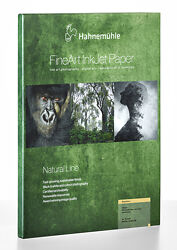
Hahnemühle Bamboo 290gsm
Our favourite warmtone fine art paper - with rich & velvety tones. It's also highly eco-friendly making it pretty much perfect in our book!
Please note that we are open by appointment only (except for click and collect pickups once notified ready).
Coatings are applied to inkjet papers to make them more receptive to high ink loads - without them, the ink would bleed and sharp results and highly saturated colours would not be possible. Coatings also play a big role in the longevity of a print. Better coatings offer more resistance to the common things that cause fading - notably gas fading and fading due to ultra-violet light.
Most modern inkjet coatings are of the micro-porous type, sometimes referred to as nano-porous. These coatings have small, invisible holes in them, into which the ink falls. Generally, if a paper is 'instant-dry' it has a micro-porous coating. Micro-porous coatings are more susceptible to gas (ozone) fading, as the gas more easily comes into contact with the actual inks. However many modern coatings have overcome this problem.
Another type of inkjet coatings are swellable
coatings. Here, the coating swells around the ink once the ink is laid
down on the paper. In general, this approach offers better resistance to
gas fading in particular. However these coatings do not work with
pigment inks. But for dye based printers, these papers can have a very
significant effect on print longevity, with some tests indicating that
the life span of a print on swellable papers can be triple that of
prints on micro-porous papers, rivaling those of pigment ink prints.All papers that we use and sell have a micro-porous coating.


Jeremy’s knowledge of images and enthusiasm for sharing his knowledge were reassuring and we left feeling confident and excited to begin printing. Starting out on this unknown journey was definitely easier thanks to Jeremy and the friendly team at Image Science.........The team at Image Science have also helped us learn more about shipping. Businesses we deal with have been impressed by the quality of the packaging from image Science when they receive the prints via post.