Featured Artist: Wendy Croxford

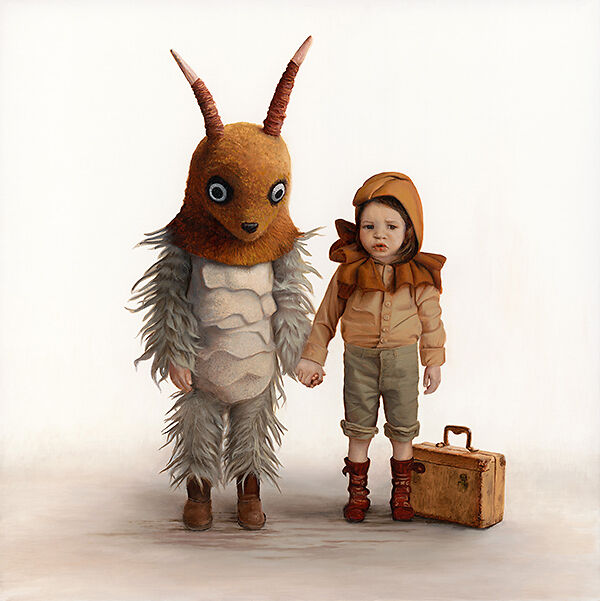
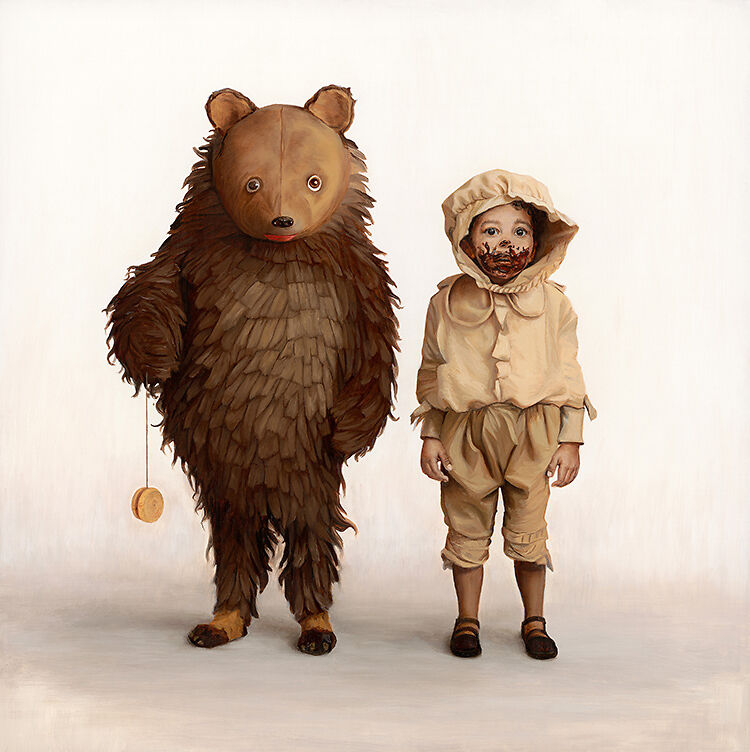
Wendy Croxford is a Melbourne-based artist whose works draw on the complex psychological space between childhood and adulthood. Working primarily in imaginative realism, the whimsically-costumed children and strange companions that inhabit Wendy's paintings become part of an imagined emotional landscape, exploring ideas around fear, vulnerability, protection, insecurity and companionship.
Her recent body of work, Silent Theatre, draws on the formative experiences of childhood and the ways they continue to shape us into adulthood, portraying scenes that feel both familiar and faintly unsettling.
We were proud to work with Wendy on digitally reproducing a collection of artworks from her Silent Theatre series. Blown away by the technical execution and conceptual depth of Wendy's work, we knew we just had to feature her.
In this interview, we chatted with Wendy about the evolution of her practice, the ideas behind Silent Theatre, and the role of childhood and storytelling in her work.
Could you tell us a little about how you first came to painting, and what inspired you to pursue it more seriously as an artist?
My first memory of making art was when I was about ten and tried to draw Daffy Duck. It was the first time I’d actually tried to make a drawing look like something, and it felt a bit like a magic trick. I was completely hooked.
I started painting as a teenager and was very drawn to traditional realism and the Old Masters. I taught myself largely by copying paintings and seeking out whatever instructional material I could find. One of my first painting tutorials was a VHS tape by Russian realist painter Alexei Antonov. I watched it so many times I had to sticky tape it back together more than once. His approach to layering paint and gradually building up that degree of realism fascinated me, particularly because I could see the potential for using those traditional techniques to make imagined things feel completely real.
Growing up in South Africa in the 1980s and 90s, though, art never really seemed like a viable way of supporting yourself. My family moved around a lot when I was young, so financial independence and eventually having a home and some stability of my own were really important to me. I never seriously considered art as a profession because of that, but I also never stopped painting or teaching myself.
It wasn’t until I moved to Melbourne and settled here with my husband that I began approaching it with much more discipline and intent. COVID accelerated that enormously. Suddenly there were fewer distractions and I had the opportunity to completely immerse myself in painting and really think about what I wanted my work to be.
The biggest shift was surprisingly simple: I stopped thinking so much about what I should paint and started asking myself what I actually wanted to paint. Once I understood that I was drawn to emotionally evocative images, ambiguous narratives and imagined characters that still felt grounded in reality, things started to click. That’s really when I began to feel that I wasn’t just learning how to paint anymore, but developing a voice of my own.
As your practice has developed, you’ve moved towards increasingly narrative and figurative work. What drew you to exploring characters and storytelling through your paintings?
I’ve always been really drawn to storytelling, particularly through film. Horror has probably had the biggest influence on me in that respect. I remember watching the film adaptation of Stephen King’s IT when I was about eleven, while my parents were out playing badminton one night, and being fascinated by how something I knew wasn’t real could create such an intense emotional response.

What I particularly love about horror is its use of symbolism. The monster, the haunting or whatever frightening thing is happening is very often a metaphor for something else entirely: grief, trauma, fear, isolation, growing up. It gives you this incredibly imaginative visual language for exploring very real human experiences without having to address them literally. I think that’s something I’ve carried into my own work.
I’m much more interested in a painting when it feels like you’ve arrived in the middle of something. There’s a character, an expression or an interaction that suggests a larger story, but you don’t quite know what has happened before or what will happen next.
Expression is particularly important to me. I’m always looking for that emotional element that makes you wonder what a character is thinking or feeling, and then I’ll usually introduce something else into the composition that complicates it or shifts the meaning slightly. I want to give enough clues to suggest that there is a story, without ever completely resolving it.
Silent Theatre is your most recent body of work, recently exhibited at BeinArt Gallery. Can you tell us a little about how the series came about, and what it was like to see it presented as an exhibition?
Silent Theatre came about during a period when I was doing quite a lot of self-reflection and trying to better understand my own psychology, why I respond to things the way I do, where certain fears or insecurities come from, and how much of who we become as adults has roots much further back than we might realise.

That led me to think a lot about the things that happen to us when we’re young and how they quietly follow us into adulthood. The children, creatures and strange little interactions in Silent Theatre grew out of that.
The title came from the idea that these psychological dramas are playing out in each painting without us ever being told exactly what is happening. They’re scenes without dialogue. We have expressions, relationships and visual clues, but the viewer ultimately has to decide what they mean.
The human psyche is such an incredibly rich subject. The more you understand about it, the more there seems to be to explore, and I can’t imagine ever exhausting it. Silent Theatre might be one body of work, but those ideas certainly aren’t finished for me. I suspect they’ll continue finding their way into my paintings for as long as I paint.
Seeing the works together at BeinArt was quite surreal. I’d spent so long with each painting individually in the studio that I hadn’t really experienced them as a complete body of work until they were all hanging together. There was something quite emotional about seeing what had been a very private period of thinking and making suddenly existing outside of me, where other people could bring their own experiences to it. In a way, that completed the work for me.
The world of childhood features strongly throughout Silent Theatre, but your paintings seem less about childhood as a time of simple innocence than in the more complex emotions that sit beneath it. What draws you to this period of life, and what makes it such a rich subject for your work?
I think what draws me to childhood is actually how complicated it is. We tend to look back on it as this period of innocence and simplicity, but when you’re a child you’re experiencing incredibly complex emotions without necessarily having the language, experience or perspective to understand them.
You’re also at your most impressionable. So much of what is happening around you is completely outside your control, and yet those experiences can quietly shape the way you see yourself and the world for decades afterwards. The relationships you observe, the things that frighten you, the ways you learn to seek approval or protect yourself — all of these little experiences can become part of the architecture of who you are.
There’s something fascinating to me about the fact that we spend our adult lives carrying around these earlier versions of ourselves, whether we’re conscious of them or not.
That’s probably why the children in my paintings aren’t particularly carefree. They’re often serious, apprehensive, defiant or absorbed in something that feels important to them. I like that tension between their apparent vulnerability and the complexity of whatever might be happening internally.
For me, childhood isn’t really the subject in itself. It’s a way of looking at how a person begins to become who they are.

The creatures that appear alongside your child figures are such an intriguing part of the world you’ve created, with a strong sense of companionship between the children and their strange counterparts. How did these characters come about, and what role do they play within the stories you’re telling?
I don’t generally begin a painting knowing exactly what the creature will be or what it represents. It evolves alongside the image. I’ll try different shapes, animals, materials or proportions until something feels right. Sometimes it never does, and I’ve learned, or am still learning, that you have to be willing to let an idea go rather than keep forcing it into something it doesn’t want to be.
I think of the creatures less as monsters and more as companions, manifestations or extensions of something psychological. They might suggest fear, protection, insecurity, imagination or something else entirely, but I deliberately don’t define that too closely.
I’m interested in the relationship between the child and the creature more than what either character represents individually. Who is protecting whom? Are they friends? Is this something the child fears, or something they need? Could it be both?
I also don’t necessarily see the creatures as sinister, even though they can be strange or unsettling. There’s often vulnerability in them too. That ambiguity is important because it means the relationship can shift depending on what the viewer brings to it. Someone might see protection where somebody else sees dependence or fear.
That’s where the story becomes interesting to me. I can create the circumstances, but I don’t necessarily want to provide the answer.
Dress-up and costume feature so prominently throughout Silent Theatre. What drew you to this idea, and how did it become part of the series?
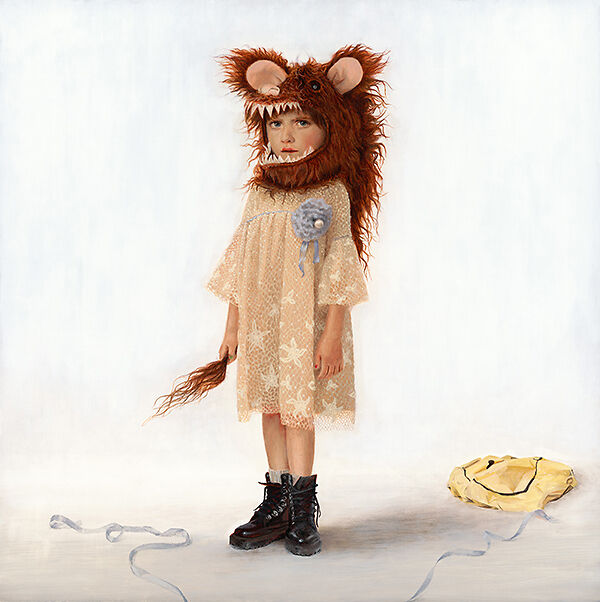
Costume actually entered the work through a fairly unlikely source, a friend’s hen’s weekend. One of the activities was to make DIY outfits from materials we’d sourced from an op shop. The results were these funny, strange, slightly uncanny creations, and something clicked for me.
I’ve always loved imagined characters, creatures and science fiction, but I’m also very committed to realism. I didn’t want to paint something that felt like it belonged in a fantasy world. Costume solved that problem. I could invent almost any silhouette or character I wanted, but because it was ultimately something constructed and worn by a person, it could still quite literally exist.
I also fell in love with the imperfection of those homemade costumes. I don’t want them to look beautifully manufactured. I like visible seams, awkward shapes, uneven hems and materials being used in ways they weren’t necessarily intended for. There’s a sincerity and charm to something a child might have constructed from whatever was available.
As I worked on Silent Theatre, I realised dress-up also fitted naturally with the psychological ideas I was exploring. As children, it’s one of the first ways we experiment with identity. You can become something powerful, frightening, heroic or completely invented for a while.
There’s also something interesting to me about costume as a kind of armour. We all construct versions of ourselves as we grow up, ways of presenting ourselves, protecting ourselves or becoming what we think we need to be. So the costumes can be playful, but they can also suggest that something more complicated is happening underneath.
Do your own memories or experiences of childhood find their way into your paintings, or are you more interested in creating imagined worlds that evoke something more universal?
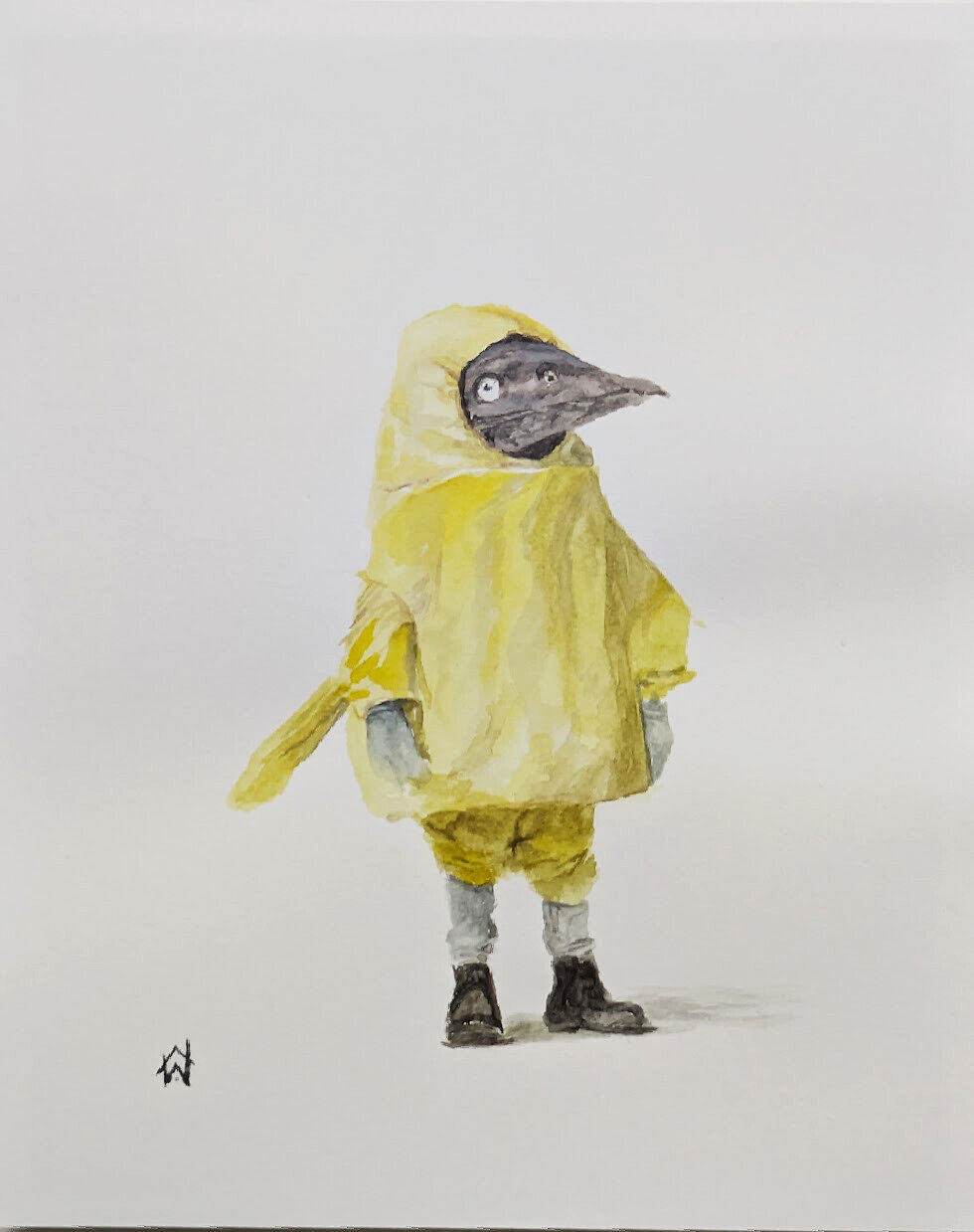
It’s probably a combination of both, although I don’t think of the paintings as autobiographical. I’m not usually recreating a particular memory or illustrating something that happened to me. It’s more that examining my own experiences has made me interested in the ways our early experiences shape all of us.
My family moved around a lot when I was growing up, so ideas around stability, belonging and finding your place in the world are inevitably part of who I am and probably find their way into the work, whether I’m consciously putting them there or not. But I’m much more interested in creating something that other people can enter than in telling my own story literally.
That’s why the worlds themselves are imagined. They give me the freedom to take a feeling or idea and build something around it without tying it to a specific event. A strange creature, a costume or the expression on a child’s face can suggest something familiar without ever explaining exactly what has happened.
I don’t really want viewers trying to work out my history when they look at a painting. I’d much rather the work trigger something from their own. If someone recognises an emotion or sees a relationship between the characters that connects to something completely different from what I was thinking about when I painted it, I love that. At that point the painting has become theirs as much as mine.
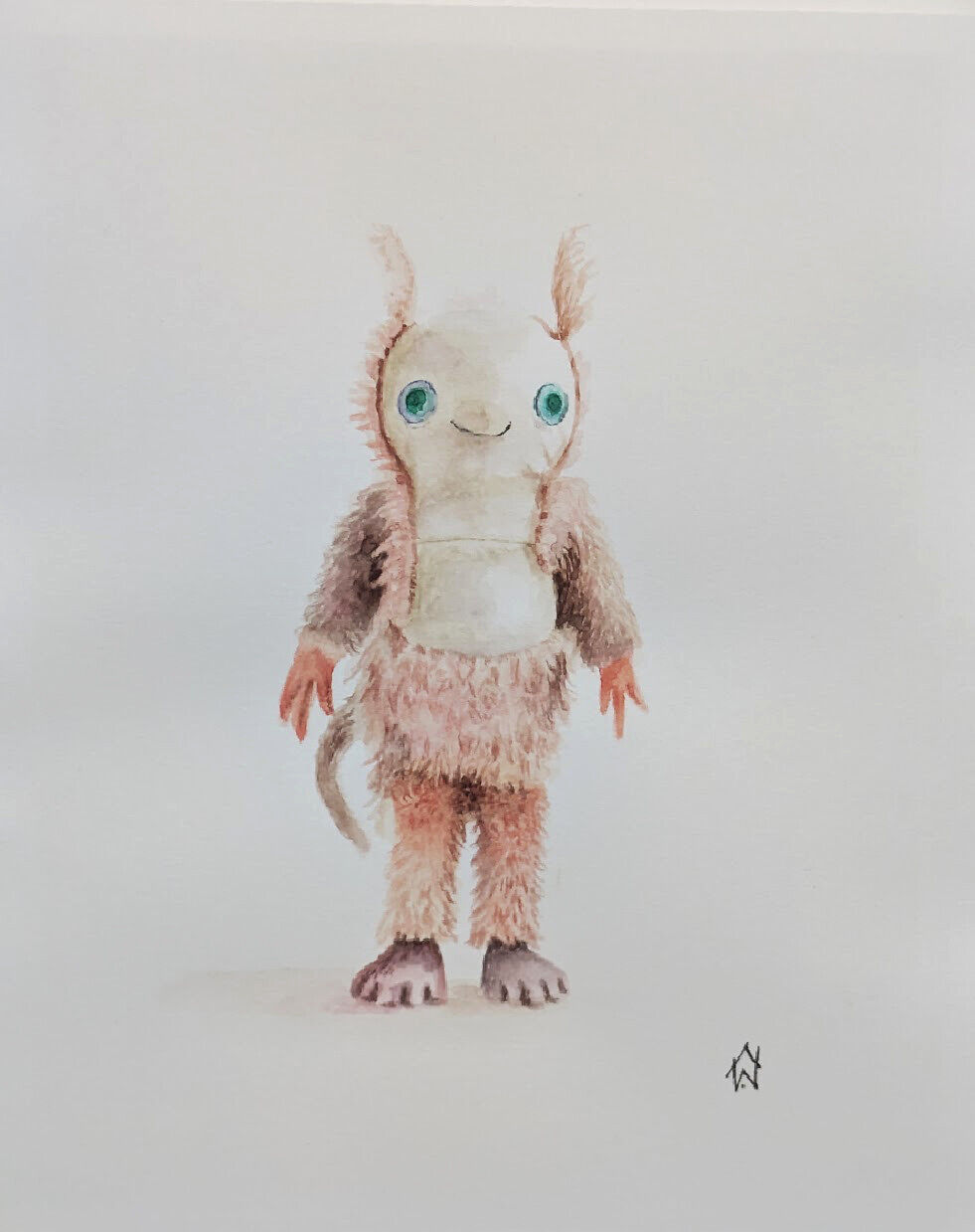
Do your paintings tend to begin with a story in your mind, or does the narrative emerge gradually as you develop the image?
It’s definitely more of a gradual process. I rarely begin with a complete story in my head. Usually there’s an emotional idea, an expression or an interaction that I find compelling, and I build outwards from there.
I spend a lot of time developing the composition before I start painting, and that’s really where the narrative begins to reveal itself. I’ll introduce a creature, costume, object or gesture and see how it changes the emotional reading of the image. Sometimes something quite small can completely shift the relationship between the characters and suddenly the image starts to make sense.
The creatures in particular tend to evolve this way. I almost never know exactly what they’ll look like at the beginning. I’ll keep changing their shape, scale, costume or relationship to the child until there’s a moment when it just lands. It feels less like I’ve invented a story and more like I’ve discovered one that was already somewhere in the image.
I actually prefer not knowing too much myself. If I started with a very specific narrative; this has happened, this character represents this, and this is what it all means, I think the finished painting would become too illustrative.
So by the time I start painting I generally know the emotional atmosphere of the scene, but not necessarily its complete story. That uncertainty is part of what keeps me interested in making it.
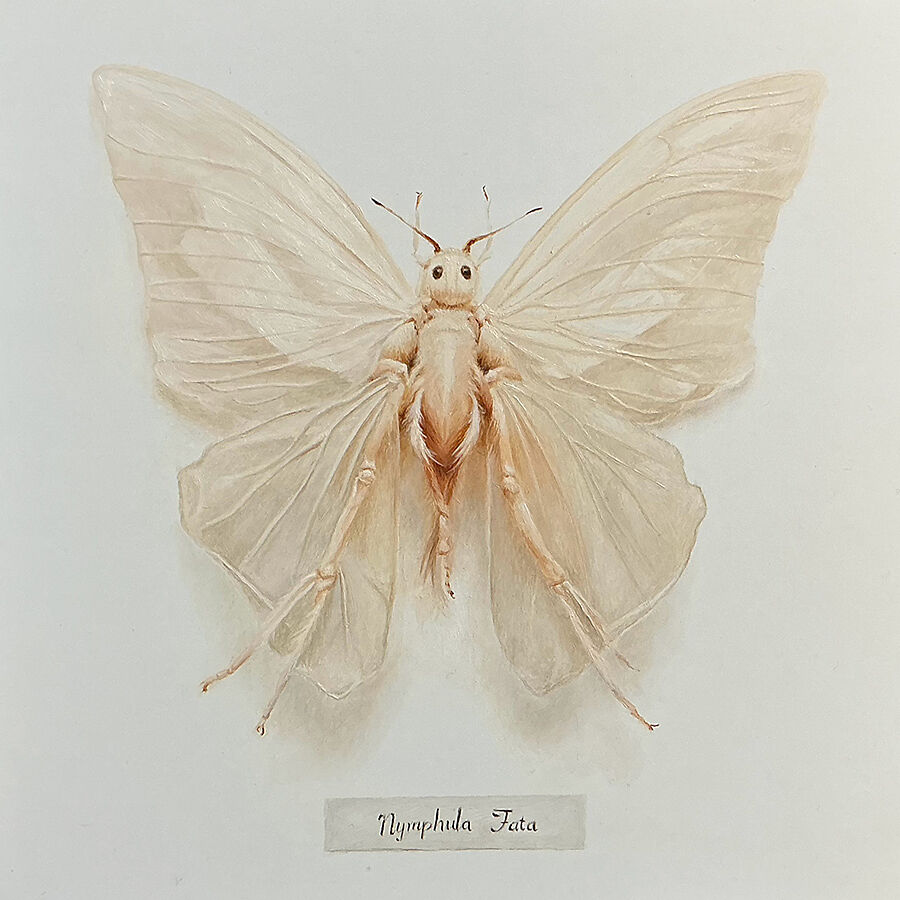
There’s an extraordinary level of detail in your paintings, particularly in the figures, costumes and small objects within each scene. How do you approach the process of building up a painting?
I still paint using the traditional layering techniques I became fascinated with when I was younger. It’s a very slow process, but I love the depth and realism it allows you to achieve.
I begin with an umber layer, which establishes the drawing, values and structure of the image. From there I build a grisaille, essentially developing the forms in monochrome before introducing colour. Then come multiple colour layers and glazes, depending on what I’m painting, with each layer allowed to dry before the next one goes down.
The different surfaces within a painting often need quite different treatment. Skin, sheer fabric, fur, metal or something rough and handmade all respond differently to layering and light, so a lot of the detail comes from gradually building those individual qualities rather than trying to describe everything in a single pass.
It’s definitely not a fast way to paint! There can be a lot of waiting between stages, but I think that slowness suits me. Each layer makes quite a subtle contribution, and then at some point all of those small decisions accumulate and the figure or object begins to feel physically present.
That sense of presence is really important to me. The detail isn’t there simply for the sake of making something highly rendered. Because so much of the imagery is imagined or slightly uncanny, the realism is what makes the world convincing. I want you to be able to see the seams in a costume, the texture of the fabric or the light on a child’s skin and feel that, however strange the scene might be, these characters could actually exist.
Looking ahead, what’s next for your practice? Are there any new projects or exhibitions you’re currently working towards that you can share?
I’m currently working on a few pieces for upcoming group shows as well as a private commission, which has been a really interesting opportunity to develop some of these ideas in a slightly different context.
I’m also very excited to have another solo exhibition confirmed with BeinArt Gallery for April 2028. It’s still early days and I’m deliberately not defining it too much yet because I’m working through what I want that body of work to become. I learned a lot through making Silent Theatre, and there are ideas within it that I definitely don’t feel finished with — particularly around psychology, identity and the ways our early experiences continue to shape us.
At the moment I’m enjoying giving myself permission to follow those threads without feeling like I need to know where they’ll end up. That’s probably how my work develops best anyway. I tend to discover what I’m trying to say through making the work rather than deciding everything in advance.
So there’s plenty happening in the studio, but I’m also quite happy for the next body of work to reveal itself slowly. April 2028 feels simultaneously a long way away and, knowing how slowly I paint, alarmingly close!