Direct Scanning and Photographic Capture for Art Reproductions
Art reproductions play a very important part in making your work more accessible. They can open up new markets for your work, and often become a critical income streams for artists - which can be used to support the creation of new originals.
A high quality digital file is the key to high quality reproductions and having this process done to all the artworks you produce before you sell them can be the difference between making a living as an artist from your work or not.
There are two methods of producing a high quality digital file - direct scanning and photographic capture.
In general, thanks to recent developments in scanner quality, the direct scanning approach for art reproduction works very well with moderate sized pieces (to about A1/poster size) - with those it usually works very well - offering tremendous resolution adn colour fideltiy - whilst being quite cost effective.
However, for larger pieces (over A1), or those with a lot of dimensionality to the work (thick impasto, physical embellishments etc) - the photographic approach can sometimes be a better way to create good quality files for digital reproduction.
The best way to find out the best approach for your work is to contact us and let us know what medium and size your work is, and ideally include some basic photographs of you work just so we can get a better idea of what we're dealing with. We'll be happy to guide you!
Direct Scanning
Direct scanning is a great way to create a high quality digital file
of smaller artworks but is generally not the ideal mechanism for
dealing with very large art works as it can be difficult to achieve perfect uniformity and focus using this approach with very large works. We tackle works up to A1 all the time, with excellent results.
The two types of works that tend to be hard to direct scan are large works and oils, particularly oils with heavy brush strokes (impasto). These works often reproduce best with a photographic approach.
Many large
scanners, such as plan scanners, touch the original works with rollers,
as they're more designed for documents and plans and have automatic
feed mechanisms. We've evaluated all the big players in the market
(Colortrac, Contex etc) and unfortunately they all visibly mark
delicate original works.
The Cruse scanner is the most heavily
touted system and scans without touching the artwork surface. However
we have often received scans of works made on these scanners and
unfortunately they are often not sharp and they have always required
significant colour work before final output.
We are not experts on this machine and they do generally have a good reputation but we can only judge based on the results we have seen. We have also seen a lot of negative commentary on the web in regards to their quality.
Our scanner is a large flatbed design. It is professional machine, made in Germany specifically for art reproduction - and is a dramatically better scanner than the scanners most services use for this (typically Epson or Microtek consumer grade scanners).
The work is very carefully placed face down on the glass, and we've never marked any work this way (some works such as pastels or charcoals may not be appropriate for this method but because the work is very carefully handled we find even those are generally no issue).
The scanner is pin sharp and highly colour accurate. Even if you think you've had quite good scans in the past, you will find our service is capable of producing results that are quite simply a closer match to your original work.
Photographic Capture
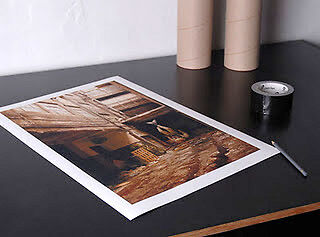
In our experience and testing, Photography simply works better than
scanning with VERY large works, or works that really require custom directional lightning (works with sculptural aspects to them, or with heavy impasto etc).
Done properly, it can be one of the most colour accurate
techniques for art reproduction in general, and results in most
scenarios are very good.
High resolution photography allows you to
properly light each piece individually for the best effect and most
accurate results - whether you want all the texture from the original
work, or a more flat reproduction. The artwork surface is never
touched, and it can in fact also be more cost effective, especially if
you have multiple pieces done at once.
The key here is to work with a specialist high end art reproduction photographer. Whilst many professional photographers will have a go at this work, thinking it easy, it is quite simply one of the most technically demanding types of photography there is, and there is a vast difference between the quality of results from a specialist vs. a regular professional photographer.
Ask Us For Our Advice
The best thing to do is to come in or give us a call and ask for our advice. With more than 15 years of experience in this area, working for some of Australia's best and most successful artists, we're very comfortable with all aspects of the process and we'll be very happy to help work out what is the right approach for reproducing your works.